
Lingerie Fabric Guide: Lace, Mesh, Satin and Bonded
Four fabric families cover most lingerie production: lace (rigid, stretch, jacquard, guipure), mesh and powernet, satin and woven silk-look fabrics, and bonded or laser-cut knits. The fabric decides the construction: a rigid lace bra is cut and sewn with darts, a stretch lace bra can be cut without darts, and a bonded bra has no seams at all.
If you are quoting a style, the fabric specification matters more than the style photo. The same silhouette in two different laces can differ by 30% in cost and by an entire fit grade.
This guide is written from the factory floor. Tianjie Lingerie has been cutting and sewing lingerie in Dongguan since 1998, and most of the arguments we have with new buyers are not about design — they are about what the fabric will and will not do once it is on a body.
Why fabric choice sets your margin before you design anything
In a bra set, fabric is typically the largest single cost line after labour, and it is the one that decides how many pieces per metre you get, how much waste the cutting room produces, and how many units fail QC. A lace with a 130 cm usable width and a repeating motif of 18 cm wastes far less than a lace with a 90 cm width and a 40 cm repeat — the price per metre can be identical and the cost per garment 20% apart.
| Family | Typical use | Stretch | Cost band | Main risk |
|---|---|---|---|---|
| Rigid lace | Bralettes, cups, overlays | None to low | Low–mid | No recovery, needs darts |
| Stretch lace | Wireless bras, briefs, bodysuits | High | Mid | Growth after washing |
| Jacquard / corded lace | Fashion sets, premium cups | Low | Mid–high | Heavy, needs support |
| Guipure / chemical lace | Bridal, statement pieces | None | High | Fragile edges, hand trim |
| Powernet | Wings, bands, shapewear | Very high, strong recovery | Low–mid | Cheap grades lose modulus |
| Soft mesh / tulle | Cups, panels, skirts | Mid | Low | Runs and snags |
| Stretch satin | Pajamas, robes, corsetry lining | Low–mid | Low–high | Shading and seam slippage |
| Bonded knit | Seamless bras, briefs, active | High | Mid | Peel strength after washes |
Lace: the four constructions behind every quote
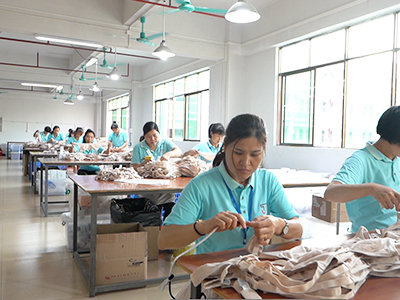
“Lace” is not a specification. When a supplier quotes you “lace”, ask which of these four it is, because they behave differently on the body and in the wash.
1. Rigid lace (raschel, no elastane)
No stretch in either direction. Used for cup overlays, bralette bodies cut on the bias, and trims. Cheap and stable, but it cannot follow a curve without darts or a seam, so it suits structured styles and not soft ones.
2. Stretch lace (raschel with elastane)
The workhorse of wireless bras and briefs. Two things matter: stretch percentage (typically 40–70% in the width) and recovery — how far it springs back after being stretched to the body. A lace that stretches well but recovers poorly grows half a size after ten washes, and that is the complaint you will get from your customers, not from your factory.
3. Jacquard and corded lace
Heavier, with a raised motif. Popular in premium sets because the pattern reads well in photos. It needs support behind it — a corded lace cup without a lining will collapse — and it is harder to cut economically because the motif has to be placed symmetrically on both cups.
4. Guipure / chemical lace
The motif is held together by the motif itself, with no ground mesh. Beautiful for bridal and occasion pieces, and the most expensive to handle: edges fray, trimming is manual, and yield per metre is low. Budget for a higher cutting loss and a slower line.
Mesh and powernet are not interchangeable
Soft mesh is a visual fabric: it goes into cups, panels and skirts where you want transparency. Powernet is a structural fabric: it goes into wings, bands and shapewear where you need modulus — force per unit stretch — so the garment holds instead of riding up.
- Check the weight, not just the look. Powernet is usually quoted in gsm; a 180 gsm and a 240 gsm powernet look identical on a swatch card and behave nothing alike in a 40 band.
- Ask for the recovery test. Stretch a 10 cm strip to 20 cm, hold it a minute, release it, measure after 30 seconds. Under 10.5 cm means the band will bag out.
- Do not substitute mesh for powernet to save cost. The saving is a few cents per garment and the return rate is the whole margin.
Satin: what the weight actually tells you
Satin for pajamas and robes is usually quoted in momme (silk) or gsm (polyester). For polyester stretch satin, 110–130 gsm is the normal pajama weight — light, drapey, and prone to showing every seam impression. 150–180 gsm drapes heavier and photographs better but costs more and needs a stronger seam finish.
| Fabric | Weight | Best for | Note |
|---|---|---|---|
| Polyester stretch satin | 110–130 gsm | Volume pajama programs | Cheapest, watch seam slippage |
| Polyester stretch satin | 150–180 gsm | Premium pajama sets, robes | Better drape, higher cost |
| Silk charmeuse | 16–19 momme | Luxury sleepwear | Dry clean, colour matching is harder |
| Satin + lace trim | mixed | Bridal and gift sets | Trim shrinkage differs from body |
Shrinkage is the most common satin complaint. If the body shrinks 3% and the lace trim shrinks 1%, the trim puckers after the first wash. Always wash-test the combination, not the fabric alone.
Bonded and laser-cut: when it beats sewing
Bonding replaces the seam with an adhesive film and heat. It removes bulk, so seamless bras and briefs sit flat under clothing, and it eliminates stitch failure entirely. What it does not eliminate is process control: bond strength depends on film choice, temperature, pressure and dwell time, and a 5 °C drift in the press shows up as edge lift after twenty washes.
- Best for: seamless bras, laser-cut briefs, sport-style bralettes, bonded edges on mesh.
- Not for: heavy lace, structured cups, anything that needs to be opened and re-sewn in rework.
- Ask for: film type, bonding temperature window, and a wash test at 40 °C for 20 cycles with peel strength measured before and after.
The six numbers that belong on every fabric spec sheet
- Composition — with percentages, and the elastane brand if it matters (some buyers specify).
- Weight — gsm for knits and mesh, momme for silk.
- Usable width — not the roll width. The difference decides your yield.
- Stretch and recovery — percentage in width and length, plus recovery after one minute.
- Shrinkage — after the wash method you will actually use (30 °C or 40 °C, tumble or line).
- Colourfastness — to washing, to perspiration, and to rubbing, usually at grade 4 minimum for underwear.

What to test before you commit to a bulk order

Ask for test reports on the exact lot you will produce, not on a swatch from last season. The four that matter for underwear are colourfastness to washing and perspiration, dimensional stability after three washes, pilling, and — if you sell in the EU — OEKO-TEX Standard 100 certification for the fabric and the trim.
Trims are where certification quietly fails: the elastic, the sliders, the bow. A certified fabric with an uncertified elastic is an uncertified garment.
Need a fabric recommendation for a specific style?
Send a reference sample or a tech pack. We will come back with two fabric options — one at target cost, one at target hand feel — and the test reports for both.